

Resumen General del Documento: “Deye Copilot”
1. Introducción – ¿Qué es Deye Copilot?
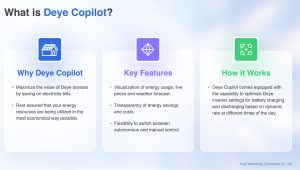


Deye Copilot que permite:
- Visualización en tiempo real del consumo energético, precios de electricidad y pronóstico del clima.
- Cambio flexible entre control manual y automático.
- Optimización de la carga/descarga de baterías con inversores Deye según tarifas eléctricas dinámicas.
- Transparencia en ahorro de energía y costes.
- Ahorro significativo en facturas eléctricas.
2. Casos de Éxito – Uso Real

Caso en Suecia
- Instalación: 24 kWp en paneles solares / 22 kWh en baterías.
- Precios horarios de importación y exportación.
- Resultados: Alta rentabilidad con ingresos por vertido del 100% durante el periodo analizado.
Caso en Australia
- Instalación similar.
- Precios cada 15 minutos.
- Ingresos diarios de hasta $275,01 y mejora del 500% respecto a la media de la red.
3. Perfil del Usuario y Requisitos del Sistema

Usuarios objetivo:
- Propietarios de vivienda (ahorro en electricidad).
- Proveedores de servicio (automatización y ampliación de almacenamiento).
- Instaladores comerciales.
Requisitos del sistema:
- Inversor solar Deye.
- Batería (marca libre).
- Sistema con estructura de tarifa eléctrica dinámica o plana.
4. Planes Tarifarios

- Compatibilidad con tarifas dinámicas y tarifas planas (pico/valle).
- Integración automática con precios del mercado eléctrico en tiempo real (sin necesidad de ingresar manualmente).
- El usuario puede elegir e ingresar su tarifa eléctrica específica.
5. Migración de Datos

Procedimiento:
Football Betting History and Development: Betzoid’s Informational Guide to Origins
Football betting represents one of the oldest and most popular forms of wagering in human history, with roots stretching back centuries before modern bookmaking emerged. The intersection of football and gambling has evolved from informal wagers between spectators to a sophisticated global industry worth billions of dollars annually. Understanding this evolution provides crucial context for how contemporary betting markets function and why football remains the world’s most wagered-upon sport. This journey from rudimentary stakes to complex betting exchanges reflects broader changes in society, technology, and our relationship with sports entertainment.
The Early Origins of Football Wagering
The practice of betting on football-like games dates back to ancient civilizations, though organized football betting as we recognize it today began taking shape in 19th century Britain. As football codified its rules in 1863 with the formation of the Football Association, spectators naturally began placing informal bets on match outcomes. These early wagers were typically arranged between individuals or through local publicans who acted as unofficial bookmakers, recording bets in ledgers and settling accounts after matches concluded.
The late Victorian era witnessed the emergence of professional bookmaking operations specifically focused on football. The introduction of the football pools in 1923 by John Moores marked a watershed moment, allowing working-class Britons to participate in football betting for minimal stakes. Littlewoods Pools revolutionized accessibility, enabling participants to predict multiple match results on a single coupon for as little as a penny. This innovation democratized football betting, transforming it from an activity primarily associated with wealthy spectators at grounds to a national pastime accessible to millions of households.
By the 1930s, football pools had become deeply embedded in British culture, with families gathering around wireless radios to hear results that would determine their fortunes. The pools system introduced concepts still fundamental to modern betting: accumulators, fixed-odds betting, and the notion that small stakes could yield substantial returns. This period established patterns of betting behavior and cultural attitudes toward football wagering that would persist throughout the 20th century and beyond.
Regulatory Frameworks and Legalization
The relationship between football betting and legal authorities has been complex and often contentious. Throughout much of the early 20th century, most forms of gambling faced strict legal restrictions in Britain and across Europe. The Betting and Gaming Act of 1960 in the United Kingdom represented a pivotal shift, legalizing off-course betting shops and creating a regulated framework for bookmakers to operate. This legislation acknowledged the reality that betting was widespread and that prohibition had proven ineffective, driving activity underground rather than eliminating it.
The establishment of licensed betting shops transformed the landscape of football wagering. For the first time, bettors could legally place wagers in dedicated premises rather than through illegal bookmakers or informal arrangements. This regulatory approach, balancing consumer protection with market freedom, became a model that other jurisdictions would later adopt. The taxation of betting activities also provided governments with revenue streams, creating economic incentives for legalization that complemented social policy considerations.
As platforms like Betzoid now demonstrate through their educational resources, understanding this regulatory history helps contextualize modern betting environments where licensing, responsible gambling measures, and consumer protections form the foundation of legitimate operations. The evolution from prohibition to regulation reflects a broader societal recognition that betting on football, when properly governed, can coexist with sporting integrity and public welfare.
Different countries adopted varying approaches to football betting regulation. While Britain moved toward legalization in the 1960s, many European nations maintained state monopolies on sports betting well into the late 20th century. The United States took a particularly restrictive approach, with the Professional and Amateur Sports Protection Act of 1992 effectively banning sports betting in most states until its repeal in 2018. These divergent regulatory paths created dramatically different betting cultures and market structures across jurisdictions.
The Digital Revolution and Modern Betting Markets
The advent of the internet in the 1990s initiated the most dramatic transformation in football betting since the introduction of pools seventy years earlier. The first online bookmakers emerged in the mid-1990s, offering unprecedented convenience and expanding betting options beyond traditional match result wagers. Bettors could now access markets from home computers, compare odds across multiple operators, and place bets on matches from leagues worldwide rather than being limited to domestic competitions.
The introduction of betting exchanges in the early 2000s, pioneered by companies like Betfair, fundamentally disrupted traditional bookmaking models. These platforms allowed bettors to wager against each other rather than against a bookmaker, with the exchange taking a commission on winning bets. This peer-to-peer model introduced lay betting—wagering on outcomes not to occur—and created more efficient markets with odds that more accurately reflected true probabilities. The exchange model demonstrated how technology could reshape fundamental market structures in the betting industry.
Mobile technology further accelerated the evolution of football betting in the 2010s. Smartphone applications enabled in-play betting, where odds continuously adjust based on match events, allowing bettors to place wagers on specific occurrences during games. This real-time betting environment created unprecedented engagement opportunities but also raised concerns about impulsive gambling behavior. The sophistication of modern betting markets, with hundreds of potential wagers available for a single match, bears little resemblance to the simple win-draw-loss options that dominated for most of betting history.
Data analytics and algorithmic pricing have transformed how bookmakers set odds and manage risk. Modern operators employ teams of traders and sophisticated models that incorporate vast datasets—team statistics, player performance metrics, weather conditions, and historical patterns—to establish betting lines. This analytical approach has made bookmaking more scientific and efficient, though it has also intensified competition and compressed profit margins, driving consolidation within the industry.
Cultural Impact and Contemporary Challenges
Football betting has become inseparable from how millions of people engage with the sport. Sponsorship deals between betting companies and football clubs, leagues, and broadcasters have created financial relationships that generate substantial revenue for football but also raise ethical questions about gambling normalization. The visibility of betting brands in football—on jerseys, stadium advertising, and broadcast partnerships—represents a dramatic shift from earlier eras when betting occupied a more marginal cultural position.
This integration has prompted ongoing debates about responsible gambling and the protection of vulnerable individuals. Problem gambling rates, while affecting a minority of bettors, represent serious public health concerns that regulators and operators continue to address through measures like deposit limits, self-exclusion programs, and advertising restrictions. The tension between commercial interests and social responsibility remains a defining challenge for the contemporary betting industry.
The globalization of football betting has created markets that transcend national boundaries, with operators serving customers across multiple jurisdictions through online platforms. This internationalization complicates regulatory enforcement and creates challenges around match-fixing, with corrupt actors potentially exploiting betting markets to profit from manipulated results. Football’s governing bodies have invested substantially in integrity monitoring systems that detect suspicious betting patterns, recognizing that the sport’s credibility depends on maintaining competitive authenticity.
Football betting has evolved from informal wagers between spectators to a technologically sophisticated global industry that generates billions in annual revenue and engages hundreds of millions of participants worldwide. This transformation reflects broader societal changes in attitudes toward gambling, the impact of digital technology on traditional industries, and the increasingly commercial nature of professional sports. As betting continues to evolve with emerging technologies like cryptocurrency and artificial intelligence, understanding its historical development provides essential context for navigating contemporary debates about regulation, ethics, and the future relationship between football and wagering. The history of football betting is ultimately a story about how human enthusiasm for sport intersects with our propensity for risk-taking, creating markets and cultural practices that continue to evolve with each generation.
- Iniciar sesión con cuenta de Solarman.
- Migración automática del historial de datos de plantas, dispositivos y organizaciones.
- Menú de acceso ubicado en la esquina superior derecha.
6. Guía de Solicitud
Pasos para aplicar:
- Completar el formulario de solicitud de Deye Copilot.
- Obtener token desde la página web de Tibber.
- Enviar el token por correo a: servicio@wccsolar.es
- Asunto: “Deye Copilot Application”
- Incluir cuenta Deye, ID de planta y token Tibber.
- Confirmación en 24 horas.
- Visualizar tarifa dinámica actualizando la página de datos de planta.
———————————————————————————————————–
️ Garantía y soporte – WccSolar
Todos estos ajustes y pruebas han sido verificados por el equipo técnico de posventa de WccSolar.
Si tienes cualquier duda o necesitas asistencia con tu inversor DEYE u otro producto, no dudes en ponerte en contacto con nosotros.
Estamos aquí para ayudarte.